
Genetic (molecular) diagnostics is the youngest branch of diagnostics mainly related to the development of molecular medicine. In the last several years we have seen a rapid development of this type of diagnostics. This is connected to the development of technologies that allow precise and fast determination of disease causality based on genetic material identification (DNA or RNA) that could belong to the targeted pathogen.
The best-known methods used for molecular diagnostics include real-time PCR (polymerase chain reaction with a real-time monitoring of product amplification), a technique which was developed in the 1980s. Real-Time PCR allows detection and amplification of nucleic acids, as well as monitoring of the reaction progress.
The solutions developed by Genomtec utilize the isothermal amplification method, which is a much newer, faster and more innovative technology than PCR, commonly used by genetic laboratories. One of its sub-types is LAMP (Loop Mediated Isothermal Amplification) technology, which requires constant temperature, thus eliminating need for heating and cooling of the reaction mixture and reducing time required for analysis. Due to the reaction occurring at a single temperature it is also possible to gain other advantages that play a significant role in point of care (POC) diagnostics, such as reduction of device dimensions and purchase cost, as well as decreasing energy consumption of the system. The LAMP method, thanks to its unique properties, works ideally in mobile devices intended for point of care testing, such as consulting rooms, clinics, ambulances, pharmacies, and hospital wards.
Genomtec’s AI pipeline transforms primer design for (RT‑)LAMP from a manual, heuristic exercise into a data‑driven, reproducible process that systematically explores sequence space, balances thermodynamics and kinetics, and anticipates off‑target risks before a single tube is run. By coupling reverse‑complement‑aware sequence models with reinforcement‑style search, the system proposes primer sets that are more likely to succeed in-vitro and remain stable across genotypes, matrices and use‑case conditions. The result is a tangible, end‑to‑end benefit profile that touches strategy, operations and clinical practice.
This pipeline shortens assay development cycles and materially improves the “hit rate” of candidate primer sets, which directly reduces wet‑lab iteration, reagent consumption and hands‑on time. Faster convergence to validated designs accelerates portfolio expansion – new panels and menu updates move from concept to verification sooner, while preserving analytical rigor.
Customers and clinicians receive assays that are tuned for decisional clarity at the point of care. AI‑optimized primer sets improve analytical specificity, reducing non‑specific amplification and ambiguous curves that can trigger repeat testing or equivocal calls. Clean fluorescence profiles support confident thresholding and shorten the time from sample to actionable result during a single visit. When clinical realities change emerging variants, regional strain diversity, shifting prevalence, the pipeline can refresh target designs quickly, enabling partners to keep front‑line menus current without the disruption of wholesale chemistry or hardware changes. In practice, this enhances patient experience, compresses care pathways and supports better antimicrobial stewardship and oncology stratification.
Diagnostics programs benefit from a deeper evidence stack. Model‑driven design provides traceable justifications for primer choice, predicted cross‑reactivity screens and robustness analyses across sequence variants, which strengthens analytical‑validation packages and de‑risks regulatory submissions. The same advantages map cleanly into IVDR / FDA documentation and post‑market surveillance plans, making it easier to demonstrate ongoing control of assay performance as epidemiology evolves. In companion diagnostics, uplift in primer‑set reliability translates to more consistent sensitivity and specificity around clinically meaningful thresholds, improving patient selection, reducing screen failures and stabilizing trial operations.
For laboratories, AI‑optimized assays reduce operational friction. Higher first‑pass success and fewer indeterminate runs cut repeat testing and save consumables, while standardized, stable primer sets minimize retraining needs for staff and simplify SOPs across sites. The quality‑control layer benefits as well: smoother amplification kinetics enable robust internal controls, drift detection and automated anomaly flags, which integrate with LIMS and ISO‑aligned audit trails. With fewer edge‑case failures and cleaner curves, throughput becomes more predictable, scheduling is easier to manage, and turnaround times compress without adding instrument complexity or power demand.
Scientists gain a principled design‑of‑experiments tool that surfaces non‑obvious primer configurations and quantifies trade‑offs between stringency, coverage and multiplex compatibility. Explainable‑AI components reveal which sequence features drive predictions, enabling targeted adjustments rather than trial‑and‑error tinkering. This supports rapid feasibility studies on difficult targets – highly conserved families, GC‑rich regions, polymorphic loci – and helps assemble mid‑plex panels with minimal cross‑talk by optimizing sets jointly rather than in isolation. The pipeline’s reproducibility and versioning also make collaboration straightforward: partners can review design rationales, share datasets and align wet‑lab verification plans with clear acceptance criteria.
The main advantage of using izothermal LAMP technology is its higher precision of pathogen detection and shorter testing time.
LAMP (Loop Mediated Isothermal Amplification) is an isothermal method, which means it occurs at a constant temperature for the amplification of genetic material (RNA, DNA). This process utilizes a special polymerase, an enzyme responsible for the synthesis of new sections of DNA strands. The polymerase utilized in the LAMP method shows DNA strand displacement activity, however, it has no exonuclease activity. This enables simultaneous relaxation of the DNA helix and synthesis of new DNA fragments, which in not possible when using PCR method.
The LAMP innovation also involves designing the primers, i.e. short oligonucleotide fragments, four to six of which are used in this method. They can hybridize from six to eight sites on the analyzed nucleic acid fragment. Such kit also contains loop primers that greatly accelerate the synthesis of newly created strands.
As it utilizes more primers in comparison to Real-Time PCR, this method exhibits extremely high specificity, short amplification time, as well as ability to detect single gene copies, while exhibiting greater tolerance to sample impurities that act as inhibitors. One temperature range for the LAMP reaction significantly reduces the time needed for the entire analytic process, which is unobtainable with of real-time PCR technique.
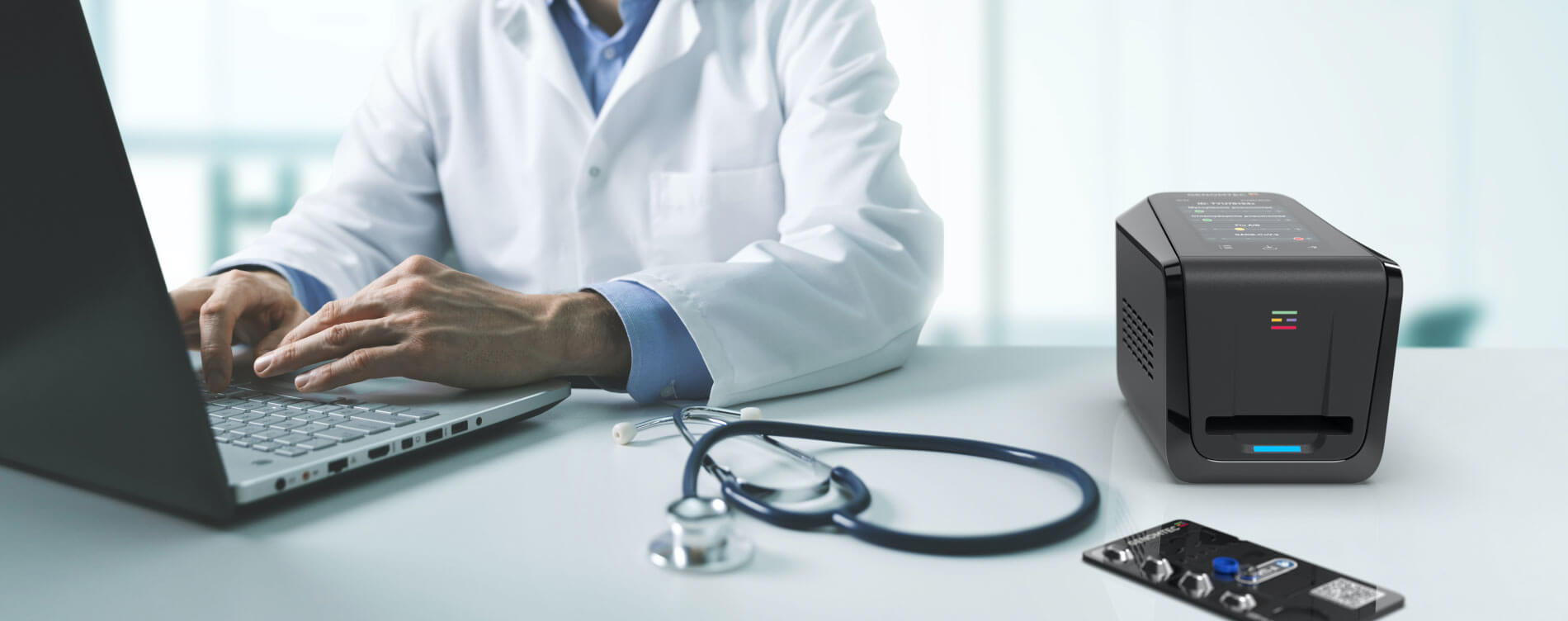
Genomtec Team has invented and patented the unique SNAAT® technology, which enables precise pathogen detection even in 15 minutes.
SNAAT® (Streamlined Nucleic Acid Amplification Technology) due to the proper design of the diagnostic system, i.e. combination of the LAMP method with microfluidics and a contactless photonic heating system, makes it possible to conduct isolation, purification, and concentration of genetic material together with amplification and detection of pathogen-specific DNA or RNA fragments in record breaking time – even in 15 minutes, while maintaining effectiveness equal or better to the currently used lab PCR methods. This shows the uniqueness of the SNAAT® technology invented and continuously developed by Genomtec.
The SNAAT® method can be used for multiplexing (simultaneous detection of multiple diagnostic targets) on microfluidic card, which means that a single diagnostic test can at once detect even up to five pathogens. The combination of nucleic acid isolation, purification and concentration stages executed onto the passive microfluidic card (with no embedded electronics nor electric parts) makes it possible for the SNAAT® to significantly reduce the limit of detection for the target nucleic acid and decrease production costs of disposable reaction cards at the same time. Excellent diagnostic parameters, including sensitivity, specificity and repeatability obtained when using SNAAT® result from the amplification process resistance to the inhibitors that can often be found in biological samples, such as blood, drugs, etc. This makes SNAAT® a unique technology designed for Point Of Care Testing (POCT).
| LOD & time | Energy and time consumption | Size | |
|---|---|---|---|
| SNAAT/LAMP |  10-15g |  and fast |  |
| PCR |  10-9g |  time-consuming |  |
PCR (Polymerase Chain Reaction) is the most often used method in genetic diagnostics. It is one of the genetic amplification (multiplication) methods using the enzymatic process in various temperature ranges. The reaction is initiated by a pair of short nucleotides complementary to DNA strand, so-called primers that guide the enzyme to a suitable amplification initiation site. This method makes it possible to analyze genetic material of low initial concentration. One of the PCR variants is the real-time PCR, where dyes or probes (fluorescently labelled nucleotides) are introduced to the reaction environment and then bind to the target nucleic acid fragment during the analysis.
The SNAAT® method is groundbreaking, as it allows integration of the complete diagnostic process into one platform, thus automating the expensive and time-consuming analytic step of the process that occurs in the diagnostic laboratory by using contactless photonic heating and microfluidics.
The proprietary SNAAT® method allows:
These processes are contactless, using photonic energy, thus revolutionizing the current standard for heating and cooling of the reaction mixture in the PCR test tube, i.e. by placing it in a thermally conductive element, so called thermoblock.
Combining contactless heating that utilizes photon energy with microfluidics makes it possible to miniaturize the system and eliminate the energy-consuming heating system based on a physical energy conduction via thermoblock. As a result we gain a mobile and automated diagnostic process.
| Property | Current standard | GENOMTEC solution | Reason |
|---|---|---|---|
| PCR | LAMP/SNAAT® | Consequence of the SNAAT® innovation | |
| Reaction temperature | Variable (three ranges) | Constant (one range) | High primer and enzyme efficiency at a reduced temperature |
| Specificity | High | Very high | Higher number of reaction initiating primers |
| Sensitivity | High | Very high | 10-100-fold greater reaction efficiency in comparison to the PCR method |
| Repeatability | High | Very high | Automation of analytical process and reaction resistant to inhibitors |
| Analyzer design | Complex optical and heating/cooling systems | Streamlined optical system, no cooling system | High intensity of fluorescence signal, constant reaction temperature |


